How Dealers Use Pre-Grading Before PSA Submissions
A practical framework for deciding which raw cards are worth official grading fees, and which should stay in the raw bin.
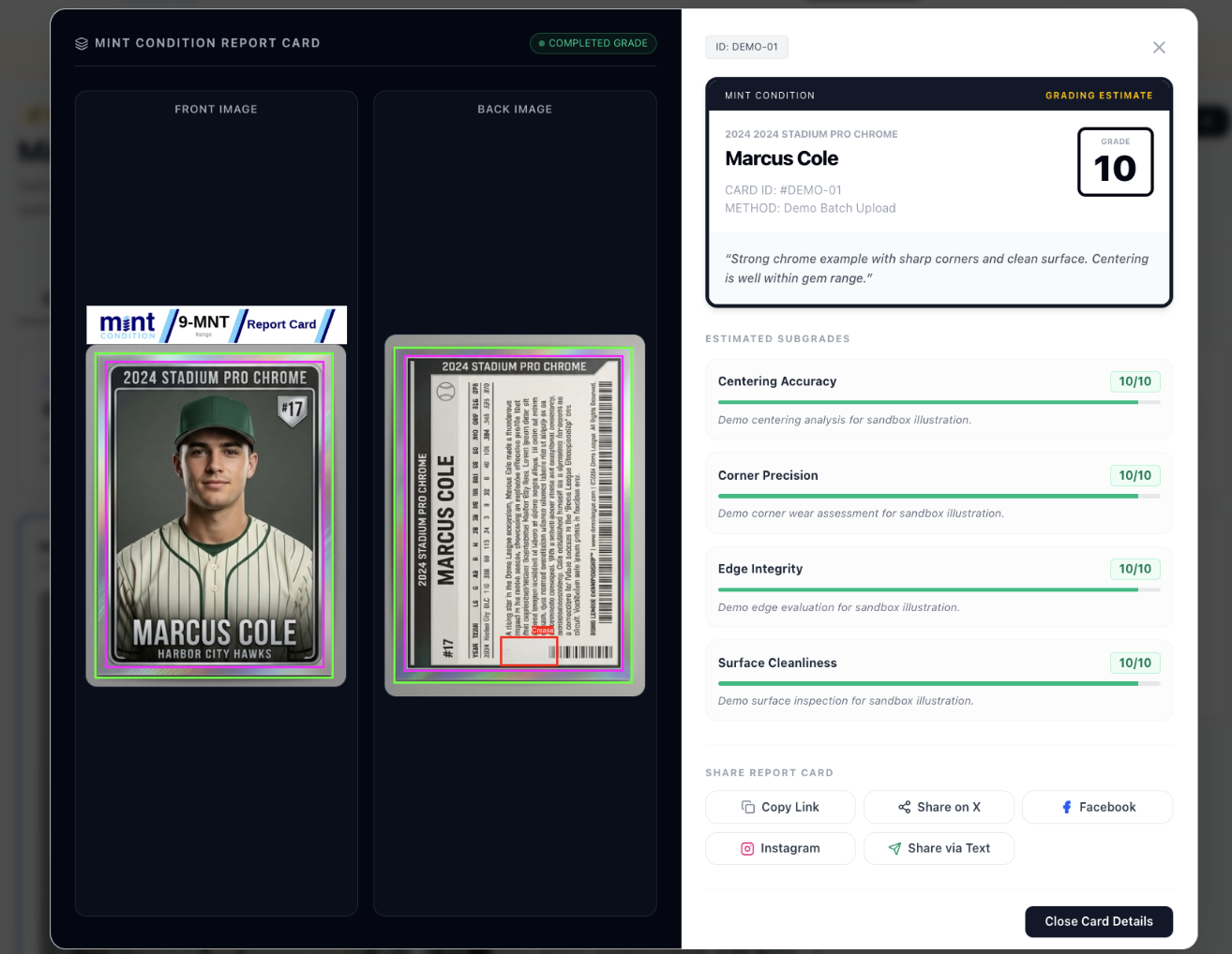
If you buy inventory at scale, the expensive mistake isn’t missing a gem. It’s sending the wrong cards to PSA.
Official grading fees, shipping, and turnaround time add up fast. Pre-grading is how dealers filter submissions before money leaves the table.
The dealer math is simple
Every raw card has three numbers:
- Likely official grade (your best estimate)
- Graded resale value at that grade
- All-in submission cost (grading + shipping + your time)
If number two minus number three isn’t worth the risk, the card should not go out the door.
Rule of thumb: If you wouldn’t list the card at a profit at the estimated grade, don’t submit it hoping for a miracle.
What to look at before you submit
Centering
Centering is the fastest filter. Cards that look "fine" to the eye often fail dealer standards on front-to-back ratio, especially on vintage stock.
Use measured centering overlays, not guesswork. A card that grades a 7 on centering alone is rarely worth a premium slab chase.
Surface and corners
Surface scratches, print lines, and soft corners are where AI pre-grading pays for itself on bulk buys. Human review at 200 cards per hour is inconsistent. A consistent pass catches defects you’d miss on card 147.
Population and comps
Pre-grade estimates should sit next to your comps. A PSA 9 on a common modern base card is not the same business decision as a PSA 9 on a short-print rookie.
A workflow that scales
Here’s the intake flow that works at high-volume shops:
- Bulk CSV for big buys (thousands of rows with front/back image URLs). This is the volume path.
- Batch scan walk-ins and smaller piles (up to 20 at a time) when you need answers now.
- Flag anything below your shop’s minimum submit grade.
- Vault the keepers with notes and estimated value, then prep only the cards that still clear margin for PSA.
The decision framework doesn’t change with volume. Bulk is how you run it when the tote (or the spreadsheet) is huge.
Pre-grading is not official grading
This matters for your customers and your team: AI pre-grading is an estimate, not a PSA, BGS, or SGC grade.
Use it to prioritize submissions and cut waste, not to guarantee outcomes. The goal is fewer bad submits, not perfect prediction every time.
Try it on your next intake
If you haven’t structured pre-grading into intake yet, start small:
- Pick one purchase from this week.
- Run it through bulk if it’s a big lot, or a batch if it’s a short list.
- Compare pre-grade results to what you would have sent blindly.
Most dealers find 15 to 30% of their "submit pile" should never have left the shop.
Buying in volume? Start with bulk CSV. Want a quick try? Run a batch or use the sandbox.